
- Knowledge Sharing
- September 3, 2026
What is a solicitor certificate?
If you are obtaining a loan, refinancing a property, giving a personal guarantee or offering your property as security, the lender may ask you to obtain independent legal advice and a solicitor certificate.
This is common with:
- Major banks.
- Second tier lenders.
- Third tier lenders.
- Non bank lenders.
- Private lenders.
- Business and commercial lenders.
- Property development lenders.
- Self managed superannuation fund lenders.
A solicitor certificate confirms that an Australian legal practitioner has provided legal advice about the relevant loan and security documents.
It is not simply a lawyer witnessing your signature.
The lawyer must review the relevant documents, explain the legal obligations and risks, verify your identity and be satisfied that you appear to understand the advice.
The purpose of the appointment is to help you make an informed decision before signing documents that could place your income, business, savings, home or investment property at risk.
Why does a lender require independent legal advice?
Loan, mortgage and guarantee documents can have serious consequences.
A lender may require independent legal advice where:
- You are borrowing money.
- You are refinancing an existing loan.
- You are guaranteeing a loan for a company.
- You are guaranteeing a loan for a family member or business partner.
- Your property is being used to secure another person’s debt.
- You may receive little or no direct benefit from the loan.
- The loan has a high interest rate or default interest rate.
- The loan must be repaid or refinanced within a short period.
- You are signing as a company director or trustee.
- The lender is taking a mortgage over your home or investment property.
- You are giving a personal guarantee and indemnity.
- Several properties or assets are being offered as security.
The lawyer’s role is to explain the legal effect of the documents and the risks you may face.
The lawyer does not decide whether the loan is financially suitable or affordable. You may also need independent financial, accounting or tax advice before proceeding.
Why can the lawyer not simply sign the certificate?
We regularly receive calls from clients and mortgage brokers saying:
“Shawn, you only need to sign this document. You do not need to do anything else.”
Unfortunately, that is not how a solicitor certificate works.
If the lender only required someone to witness your signature, it could ask you to attend a Justice of the Peace or another authorised witness.
The lender is asking you to obtain independent legal advice because it wants evidence that a qualified lawyer has reviewed the documents, explained the legal effect and risks, and confirmed that you appeared to understand the advice.
The lawyer’s signature is therefore not a simple administrative formality. It carries legal and professional responsibility.
The lender wants protection if something goes wrong
A lender may rely on the solicitor certificate if a dispute arises later.
For example, if the loan goes into default, the lender may:
- Demand immediate repayment.
- Charge default interest.
- Commence court proceedings.
- Enforce a personal guarantee.
- Take possession of secured property.
- Sell a home or investment property.
- Recover legal and enforcement costs.
The borrower or guarantor may then say:
- “I did not understand what I signed.”
- “Nobody explained the guarantee to me.”
- “I did not know my property could be sold.”
- “I was pressured into signing.”
- “I did not receive any benefit from the loan.”
- “I did not understand that I could become personally responsible for the debt.”
The lender may rely on the solicitor certificate as evidence that independent legal advice was provided.
This is why the lender requires more than a witnessed signature.
The lender is placing responsibility on the lawyer
When a lender requests a solicitor certificate, it is asking the lawyer to accept professional responsibility for the independent legal advice process.
Once the lawyer signs the certificate, the lender may rely on it when advancing the loan funds.
The lawyer may then be exposed to a claim if the borrower or guarantor later says that the documents were not properly explained or that they did not understand the risks.
The lawyer cannot accept that responsibility without completing the required legal work.
What could happen if a lawyer simply signed?
If a lawyer signs a certificate without reviewing the documents and providing proper advice, the consequences can be serious.
If the loan later fails, the borrower or guarantor may lose money, face court proceedings or risk losing a property.
The client may then make a professional negligence claim against the lawyer. The lender may also attempt to bring a claim if the certificate contains an inaccurate statement.
The matter may become a claim against the lawyer’s professional indemnity insurance.
Everyone may then ask why the lawyer signed the certificate without properly reviewing the documents, explaining the risks and confirming the client’s understanding.
Saying that the client, lender or mortgage broker requested “only a signature” would not excuse the lawyer from their professional obligations.
If it were truly only a signature, the lender would not require independent legal advice from an Australian legal practitioner.
Why can the mortgage broker not decide what the lawyer must do?
A mortgage broker may assist with arranging finance, but the broker cannot determine what legal advice the lawyer must provide.
The broker may be focused on obtaining approval and completing settlement quickly. The lawyer has a separate duty to protect the client and comply with professional obligations.
A mortgage broker should not:
- Tell the lawyer that legal advice is unnecessary.
- Decide how much time the appointment should take.
- Answer questions on behalf of the client.
- pressure the lawyer to sign an incomplete certificate.
- suggest that the certificate is only a witnessing requirement.
- influence the independent legal advice process.
The lawyer must independently decide:
- What documents must be reviewed.
- What advice must be given.
- Whether a conflict of interest exists.
- Whether an interpreter is required.
- Whether the client understands the transaction.
- Whether the requested certificate can properly be signed.
What must the lawyer do before signing?
Before signing an approved solicitor certificate, the lawyer may need to:
- Open a legal file.
- Conduct a conflict check.
- Confirm who the lawyer represents.
- Review the complete loan and security documents.
- Verify the client’s identity.
- Meet with the client privately.
- Explain the loan agreement.
- Explain any mortgage, guarantee or indemnity.
- Explain the consequences of default.
- Explain what property and assets may be at risk.
- Ask who will receive the benefit of the loan.
- Consider whether the client is being pressured or influenced.
- Arrange an independent interpreter where required.
- Test the client’s understanding.
- Keep a detailed record of the advice.
- Complete the correct client acknowledgement.
- Complete the approved practitioner certificate.
The lawyer may refuse to sign if documents are missing, the client does not understand the transaction or the certificate asks the lawyer to confirm something that is not true or known.
What documents may be involved?
Depending on the transaction, the documents may include:
- A loan agreement.
- A facility agreement.
- A mortgage over real property.
- A personal guarantee.
- An indemnity.
- A general security agreement.
- A deed of priority or subordination.
- A director’s declaration.
- Company documents.
- A trust deed.
- Self managed superannuation fund documents.
- A lender acknowledgement.
- A solicitor certificate.
All relevant documents should be provided to the lawyer before the appointment.
If documents are missing, incomplete or later changed, the lawyer may be unable to provide proper advice or complete the certificate.
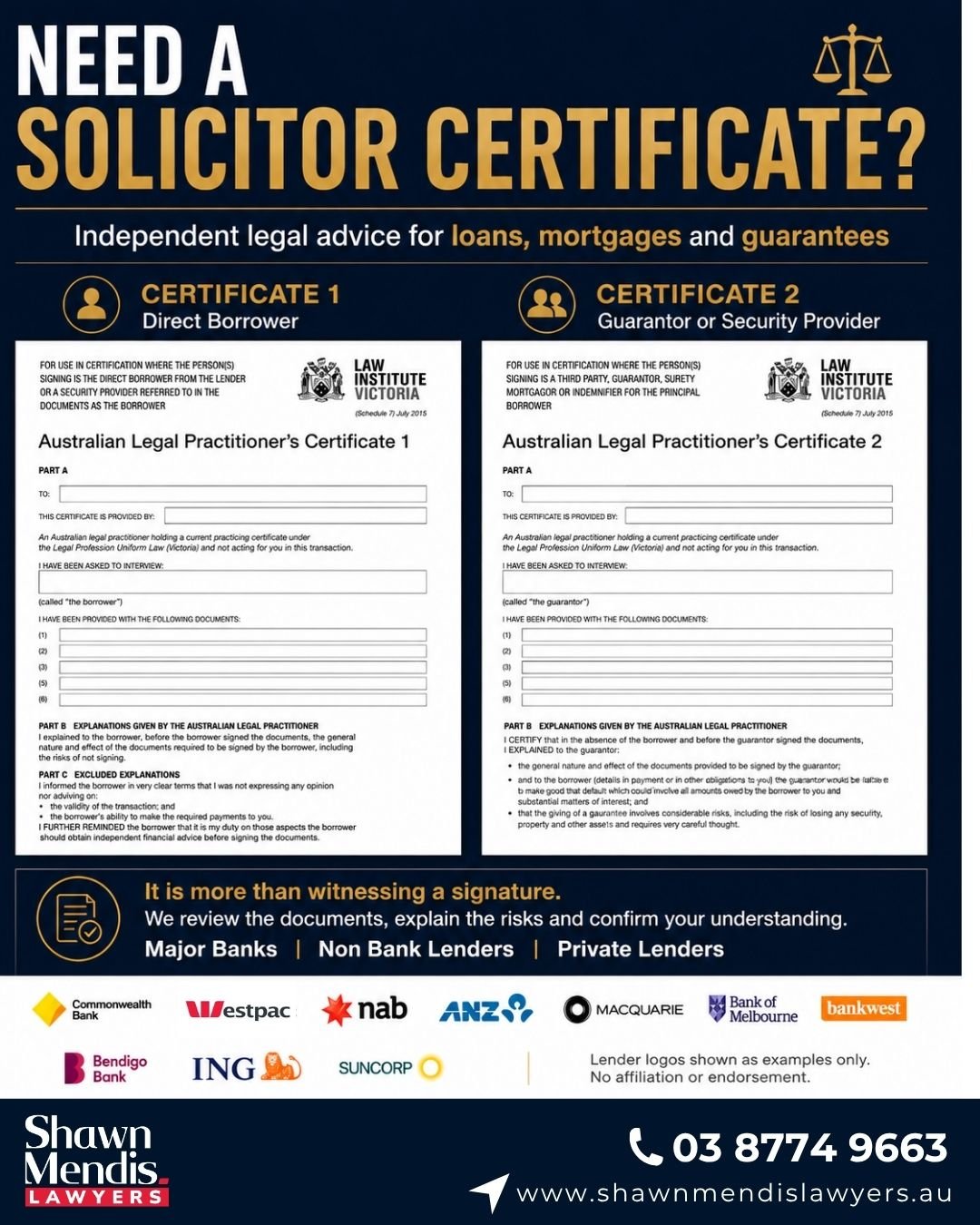
Australian Legal Practitioner Certificate 1
Australian Legal Practitioner Certificate 1 is generally used where the client is the direct borrower or is described in the documents as the borrower.
For example, you may borrow money in your own name and give the lender a mortgage over your property. Certificate 1 may be the appropriate approved form.
The lawyer will generally explain:
- The amount being borrowed.
- The purpose of the loan.
- The interest rate.
- How interest may change or accumulate.
- The repayment requirements.
- The term of the loan.
- Events that may place you in default.
- Default interest.
- Establishment and administration fees.
- Legal and enforcement costs.
- The lender’s rights under a mortgage or other security.
- The possibility that secured property may be sold.
- Any indemnity or continuing obligation contained in the documents.
Sometimes a person is described as the borrower even though a family member, company or another person will receive the real benefit of the loan.
In that situation, the lawyer must consider the true nature of the transaction and explain the additional risks.
Australian Legal Practitioner Certificate 2
Australian Legal Practitioner Certificate 2 is generally used where the client is a third party guarantor, surety mortgagor or indemnifier for the principal borrower.
For example, a parent may guarantee a loan obtained by their child and offer the family home as security. A company director may personally guarantee the company’s debts. A property owner may also give the lender a mortgage without receiving any of the loan funds.
A guarantee can create serious personal liability.
The lawyer will generally explain:
- You may become personally responsible for the borrower’s debt.
- The guarantee may cover more than the original loan amount.
- You may also be responsible for interest, default interest, fees and enforcement costs.
- The lender may take action against you if the borrower defaults.
- The lender may not need to exhaust every remedy against the borrower before taking action against you.
- Your property may be sold if the secured debt is not paid.
- The guarantee may continue after the original loan arrangement changes.
- The guarantee may cover further amounts advanced by the lender.
- An indemnity may give the lender separate and additional rights.
- You may receive no direct financial benefit from the loan.
- Your personal assets may be exposed if the borrower cannot repay the debt.
A guarantor should normally receive advice separately from the borrower. This protects the independence and confidentiality of the advice and helps avoid a conflict of interest.
How does the solicitor certificate process work?
Step 1: Provide the documents
Send the complete loan and security documents to the law firm before your appointment.
You should also provide the lender’s instructions and the exact certificate required.
The lawyer needs enough time to review the documents properly. Large or complex documents should not be provided immediately before settlement.
Step 2: Conflict check
The law firm will conduct a conflict check to confirm that it can provide independent advice.
The same lawyer may be unable to advise both the borrower and guarantor where their interests may differ.
Step 3: Verification of identity
The lawyer must confirm your identity using appropriate original identification documents.
You will generally need to provide current photo identification and any additional identification requested by the law firm.
Step 4: Private legal advice conference
The lawyer will normally meet with you privately.
If you are a guarantor, the borrower, finance broker or person receiving the benefit of the loan should not answer questions for you or influence your instructions.
This allows you to speak openly and make your own decision.
Step 5: Explanation of the documents
The lawyer will explain the important terms and risks of the loan, mortgage, guarantee, indemnity and other security documents.
The lawyer may ask:
- Why are you entering the transaction?
- Who will receive the loan funds?
- What benefit will you receive?
- What property or assets are being placed at risk?
- How will the loan be repaid?
- What will happen if the borrower cannot repay the loan?
- Have you been pressured to sign?
- Do you need financial, accounting or tax advice?
Step 6: Confirming your understanding
The lawyer may ask you to explain the main obligations and risks in your own words.
This is not intended to embarrass or test you. It helps the lawyer confirm that you understand the transaction and are making an informed decision.
Step 7: Signing and certification
If the lawyer is satisfied that proper advice has been provided and all requirements have been met, the relevant acknowledgement and approved practitioner certificate may be signed.
The lawyer may refuse to sign where:
- Important documents are missing.
- The documents are incomplete or inconsistent.
- Your identity cannot be properly verified.
- You do not appear to understand the transaction.
- You appear to be pressured or influenced.
- A conflict of interest exists.
- A professional interpreter is required but has not been arranged.
- The certificate contains statements the lawyer cannot verify.
- The certificate asks the lawyer to confirm something that is not true or known.
A solicitor certificate is a statement of fact
A solicitor certificate is not a rubber stamp.
A lawyer should only certify something that is true and within the lawyer’s knowledge.
Rule 11 of the Legal Profession Uniform Legal Practice Solicitors Rules 2015 regulates the approved evidence of legal advice in loan and security matters.
Victorian practitioners generally use the approved Law Institute of Victoria forms or the approved Law Society of New South Wales forms.
A lender may sometimes provide its own additional certificate. That certificate may ask the lawyer to confirm broad facts or legal opinions concerning:
- The validity of a trust.
- The trustee’s authority.
- Whether the transaction benefits the trust.
- Whether the loan is commercially appropriate.
- Whether the borrower can afford the loan.
- Whether all information provided to the lender is accurate.
- Matters outside the lawyer’s actual knowledge.
A responsible lawyer will not automatically sign such a certificate.
The lawyer may ask the lender to accept the approved practitioner certificate, amend the additional certificate or provide further information.
In some cases, the lawyer must refuse to sign the lender’s certificate.
This does not mean the lawyer is unnecessarily delaying the loan. The lawyer must protect the client and comply with professional obligations.
Major banks, second tier lenders and private lenders
The purpose of independent legal advice remains the same regardless of the lender. However, the documents, costs and risks may differ.
Major banks
Major banks generally use established loan and security documents. They may have a standard process for independent legal advice.
Even where the documents appear familiar, the lawyer must consider the particular transaction and the client’s circumstances.
You should not assume that a document is safe simply because it comes from a major bank.
Second tier and third tier lenders
Second tier and third tier loans may involve:
- Higher interest rates.
- Higher default interest rates.
- Shorter loan periods.
- Establishment fees.
- Brokerage fees.
- Legal costs.
- Valuation costs.
- Strict repayment requirements.
- Broad enforcement rights.
- A requirement to refinance by a particular date.
The borrower must understand what may happen if a payment is missed or the loan cannot be refinanced before the due date.
Private lenders
Private lending may be useful where funds are required quickly or ordinary bank finance is unavailable.
However, private loans may involve significant risks, including:
- High interest rates.
- High default interest rates.
- Short repayment periods.
- Large establishment fees.
- Personal guarantees.
- Mortgages over property.
- General security agreements.
- Caveats over property.
- Strict default provisions.
- Significant enforcement costs.
Private lending documents should be reviewed carefully and should never be treated as a routine signing exercise.
The lawyer providing independent legal advice does not normally negotiate the commercial terms unless separately engaged to do so.
If you want the lawyer to negotiate interest rates, repayment terms, default provisions or other clauses, you should discuss this before the appointment.
What should you provide?
You should provide:
- The complete and final loan documents.
- All mortgage, guarantee and security documents.
- The lender’s instructions.
- The certificate required by the lender.
- Current original identification.
- Details of the borrower and lender.
- Details of all guarantors and security providers.
- Details of any property being offered as security.
- Information about who will receive the loan funds.
- Information about the purpose of the loan.
- Any relevant company or trust documents.
- Details of the settlement or signing deadline.
Do not leave the appointment until the day of settlement.
The lawyer may need time to review the documents, obtain missing information, arrange an interpreter or raise concerns with the lender.
What if English is not your first language?
Tell the law firm when making the appointment if you require language assistance.
An independent professional interpreter may be required. The interpreter may also need to complete an interpreter certificate.
A family member, borrower, mortgage broker or person benefiting from the loan should not act as your interpreter.
This is particularly important where that person may have an interest in you signing the documents.
Frequently asked questions
Can the same lawyer act for the borrower and guarantor?
This may create a conflict of interest. Separate legal advice is generally appropriate where the borrower’s and guarantor’s interests may differ.
Does the certificate confirm that I can afford the loan?
No. A solicitor certificate does not confirm affordability and does not mean the lawyer recommends the transaction.
You should obtain independent financial, accounting or tax advice where required.
Can the appointment be completed in a few minutes?
Proper legal advice takes time.
The length of the appointment will depend on the number and complexity of the documents and your personal circumstances.
A lawyer should not provide a certificate without properly reviewing the documents and explaining the relevant risks.
Can I sign the documents before seeing the lawyer?
Speak with the law firm before signing anything.
The lawyer must follow the required witnessing and certification process and may need to see you sign particular documents.
Can the appointment be completed online?
This will depend on the lender’s requirements, the documents, verification of identity requirements and the lawyer’s professional obligations.
The law firm can advise whether an online appointment is appropriate after reviewing the documents.
Can a lawyer refuse to sign the lender’s certificate?
Yes.
A lawyer should not certify a statement that is untrue, uncertain or outside the lawyer’s knowledge.
An approved Australian Legal Practitioner Certificate may still be available where an inappropriate additional lender certificate is declined.
What happens if I do not obtain the certificate?
The lender may refuse to advance the funds or complete the transaction until its independent legal advice requirements are satisfied.
You should obtain the lender’s requirements early and allow enough time for proper legal advice.
Need a solicitor certificate in Victoria?
Shawn Mendis Lawyers assists borrowers, guarantors, company directors, trustees and property owners with independent legal advice for loan and security documents.
We can assist with finance involving:
- Major banks.
- Second tier lenders.
- Third tier lenders.
- Non bank lenders.
- Private lenders.
- Business loans.
- Commercial property finance.
- Residential property finance.
- Personal guarantees.
- Mortgages and other security documents.
Our focus is to explain the documents and legal risks in clear and simple language while completing the proper certificate process efficiently.
We will always try to assist with urgent matters where possible. However, we will not sign a certificate without completing the necessary legal work.
This protects the client, the lender and the integrity of the transaction.
To help us assess your matter promptly, please send the complete loan documents, lender instructions and proposed certificate when requesting an appointment.
Contact Shawn Mendis Lawyers to arrange an independent legal advice appointment for your loan, guarantee, mortgage or security documents.
Important information
This article contains general information only. It is not legal, financial, accounting or tax advice.
The appropriate legal advice and certificate will depend on the documents and circumstances of each transaction.